


Cart
0

Last Updated: November 5, 2026
Quick Summary
Buying clothing online safely starts with checking the store is legitimate before entering card details, then confirming sizing against the store's own chart and reading the return policy. Pay with a method that offers dispute protection, such as a credit card, and avoid gift cards or wire transfers.
- Search the store's legal company name in your state's business registry before buying.
- Check the domain age, since a store registered only weeks ago is a red flag.
- Compare your body measurements with the store's size chart, not your usual label.
- Pay with a credit card or other method that offers dispute protection.
- Read the return policy first, watching for short windows and store-credit-only refunds.
Table of Contents
- Why Online Clothes Shopping Goes Wrong (And How to Dodge It)
- Step 1: Check the Store Is Legitimate Before You Enter Any Card Details
- Step 2: Work Out How to Buy Clothes Online That Fit
- Step 3: Check Clothing Quality Online Before You Hit Buy
- Step 4: Pay Safely and Protect Your Personal Data
- Step 5: Read the Online Clothing Return Policy Before You Order
- Common Mistakes and Counterfeit Traps to Avoid
- Your Next Order: Put the Checklist to Work
- Frequently Asked Questions
Why Online Clothes Shopping Goes Wrong (And How to Dodge It)
Buying clothing online is brilliant until the box arrives and the shirt looks like it was made for a much smaller, sadder person. We have all been there, usually while muttering at the tracking page. Usually the damage is small: a wrong size, a faded colour, a hoodie that pills after one wash. Sometimes it is worse, like a card number handed to a shop that never ships anything.
The good news is that most bad online clothing buys follow a few predictable patterns. Once you know them, they are much easier to dodge. This guide walks through a simple, step-by-step approach to buying clothing online safely, so your money goes on gear you will actually wear instead of gathering dust like a gym membership.
Here is the short version of what goes wrong most often:
- The store is a fake or a fly-by-night operation
- The sizing does not match the size chart you trusted
- The fabric looks nothing like the photos
- Payment or personal details get exposed
- The return policy turns out to be a trap
Each of these has a fix. We will go through them in order.
Step 1: Check the Store Is Legitimate Before You Enter Any Card Details
Before you type a single digit of your card number, spend two minutes checking the store, because buying clothing online from a shop that vanishes overnight is a very expensive way to learn a lesson. A legitimate shop usually has a real physical address, a working phone number or email, and clear company details in the footer. A shop with none of those is a red flag.
Here is how to actually verify a clothing seller before checkout:
- Find the company name, not just the brand name. Search that legal name in your state's business registry or the Secretary of State's business search. A real retailer is registered somewhere; a fly-by-night operation often is not.
- Check the domain age. A store selling "designer" coats from a domain registered three weeks ago is a costume party, not a business. Free WHOIS lookup tools show registration dates.
- Reverse-image search the product photos. If the same photo appears on five other stores under different names, you have found a drop-shipper or a clone site, not an authorized seller.
- Read reviews off-site. Look on independent review platforms and community forums, not the store's own testimonial carousel. Search the store name plus "scam" and see what surfaces.
- Test customer service before you buy. Send one pre-sale question. A real retailer answers; a fake one ghosts you or replies with a copy-paste non-answer.
- Inspect the checkout page itself. A sudden redirect to a different domain at payment, a checkout that asks for more than name, address, and payment, or a page with broken formatting are all signs the "shop" is a template with a card skimmer bolted on.
Watch out: Cheap clone sites copy a real brand's logo and photos and even mirror its About page. Check that the domain name matches the brand you actually want, and be suspicious of lookalike spellings, one swapped letter is the oldest trick in the fake-store playbook.
If a store promises huge discounts, pressures you with countdown timers, or only accepts unusual payment methods, slow down. Those tricks are common in fake shops. Search the store name together with the word "review" before you buy. If nothing comes up except the store itself, that silence is your answer.
Step 2: Work Out How to Buy Clothes Online That Fit
Sizing is the biggest reason people return online clothes. The fix is simple, even if it takes a few minutes. Start by measuring yourself properly with a soft tape: chest or bust, waist, hips, and inside leg for trousers. Write the numbers down.
Then compare those numbers with the store's size chart, not the size you wear somewhere else. Brands cut differently. A medium from one shop can fit like a small from another.
Read the product description and customer reviews for fit notes. Comments like "runs large" or "fits true to size" are gold. If several reviewers say a top is short in the body, believe them.
Our tips for sizing with confidence:
- Measure a piece of clothing you already love and compare it to the chart
- Choose the size that matches your garment measurements, not your usual label
- Check whether the fabric stretches, since stretchy cloth fits differently
- Keep notes on what fits you so future orders get easier
Sizing is the biggest reason online clothes get sent back, so here is a quick reference for getting it right.
| Check | What to do | Why it matters |
|---|---|---|
| Body measurements | Measure chest or bust, waist, hips, inside leg | Gives you a baseline to compare |
| Size chart | Compare against the store's chart, not your usual label | Brands cut differently |
| Garment measurements | Use the flat width and length of the item | More useful than body sizes |
| Reviews | Look for "runs large" or "fits true to size" | Real fit notes from buyers |
| Stretch fabric | Check whether the cloth stretches | Stretch fabric fits differently |
Step 3: Check Clothing Quality Online Before You Hit Buy
Product photos can make almost anything look good. To judge quality, look past the glossy shot and find the details. Good shops show close-ups of stitching, seams, and prints. They also name the fabric and its weight, which tells you how thick and durable the garment will be.
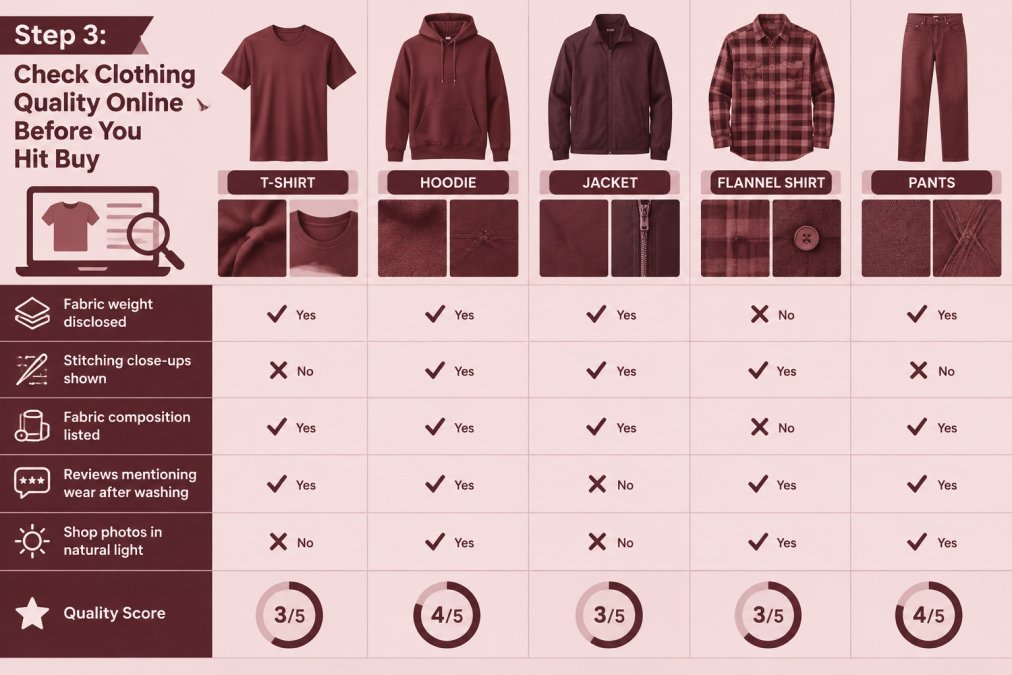
Here is a quick quality checklist:
- Fabric composition is listed (cotton, polyester, blend, and so on)
- Fabric weight is stated, or reviews mention how heavy it feels
- Close-up photos show stitching and finishing
- Photos were taken in natural light, so colours look accurate
- Reviews mention how the item holds up after washing
Colour is tricky online. Screens vary, so a "navy" might look black on your phone. Check whether the store offers several colour photos, and read reviews for comments on whether the shade looks like the picture.
Watch out: Be careful with listings that show only one tiny photo and a vague description. Thin, unclear listings often hide thin, poorly made clothes.
Step 4: Pay Safely and Protect Your Personal Data
Once you have picked the right size and quality, the last part is paying safely.
Choose a payment method with a dispute process. Credit cards generally offer stronger dispute options than debit cards, because the money leaves a debit account immediately.
Lock down your accounts. Use a unique password for every shopping account and a password manager so you are not reusing the same one everywhere. Turn on two-factor authentication wherever it is offered.
Handle phishing like a suspicious package. Scam emails and texts imitate order confirmations, delivery updates, and refund notices. Do not click links in unexpected messages.
If a charge goes wrong, document and escalate. Save your order confirmation, take screenshots of the listing and checkout, and photograph the item when it arrives if there is a problem. Report suspected fraud to the official consumer protection agency for your country, and if a package you never ordered shows up, report it rather than engaging (ReportFraud.ftc.gov).
Watch out: A store that only accepts payment by gift card, wire, or a peer-to-peer app with no buyer protection is not offering convenience, it is removing your ability to get your money back.
Step 5: Read the Online Clothing Return Policy Before You Order
Before you order, find the return policy and read it. A good online clothing return policy is clear about three things: how long you have to return an item, who pays for postage, and whether you get a full refund or store credit.
Watch for these common traps:
- Very short return windows, such as 7 days for a 30-day delivery window
- Final sale items that cannot be returned at all
- Return shipping that is charged to you, often at a high cost
- Refunds only as store credit, not money back to your card
Keep your order confirmation and any photos of the item when it arrives. If something goes wrong, that paperwork helps with a refund request or a dispute with your card company.
Now compare policies across stores. A slightly higher price with free returns can cost you less than a bargain with a difficult return process.
Common Mistakes and Counterfeit Traps to Avoid
Some mistakes come up again and again, so it helps to name them:
- Ordering the same size from a new brand without checking the chart
- Trusting a photo more than the fabric details
- Skipping the return policy because you are excited
- Buying from a listing that copies a famous brand's photos but has no real company behind it
- Paying with a method that gives you no protection
Counterfeit traps are a special worry. A listing for a famous streetwear label at a steep discount is often fake. Check that the brand's logo, stitching, and labels match the official versions, and buy from authorised sellers where you can.
Your Next Order: Put the Checklist to Work
You do not need to become an expert to shop online safely. Just run through the same steps every time: check the store, measure and compare sizes, look hard at quality, pay with protection, and read the returns page before you click buy.
Once you have a checklist you trust, online shopping gets far less stressful. Whenever you are ready to browse, check out our Oily Rag Apparel collection of durable hoodies and tees, or read up on our quality signs guide before you buy. Our Mechanic Hoodies for Men range is a good place to start if you want gear built for the shed.

Frequently Asked Questions
What is the 3-3-3 rule for clothes?
The 3-3-3 rule is a loose capsule-wardrobe idea: pick three pieces you can wear together in three different ways, then build a small outfit set from them. It is not a sizing or safety standard, so do not rely on it to judge fit or quality. Use it as a filter before you buy. If a new item does not combine with at least three things you already own, skip it. Measure against your body and the brand's size chart first, then use the rule to keep your purchases focused and reduce impulse orders you later regret.
What are some tips for buying clothes online?
Start with your own measurements, compare them to the store's size chart rather than the letter size, and read reviews for comments on fit. Check whether product photos show the garment from several angles and whether the fabric composition is listed. Confirm the return and exchange window, who pays return shipping, and the delivery time before you pay. Keep a record of your order confirmation and any messages with customer service in case you need to dispute a charge later.
How can I tell if an online clothing store is safe?
Look for a physical address, working contact details, a clear returns page and a secure checkout that begins with https. Search the store name together with words like 'reviews' or 'scam' and read the results critically. Be wary of prices far below comparable brands, countdown timers that pressure you to buy now, and product photos that appear copied from other sites. If you cannot find a real company behind the site, do not enter your card details.
What should I check before ordering clothing online?
Check the size chart and the item's measurements, the fabric and care label details, the return policy, shipping costs and estimated delivery date. Confirm the payment method is secure and that you are on the store's real domain. Save screenshots of the product page and the policies, since these can help if an item arrives different from how it was listed. Doing this in five minutes usually prevents a much longer return or chargeback process later.


