


Cart
0

Last Updated: November 7, 2026
Quick Summary
Classic muscle car t-shirts for men are best chosen by era and body style first, then judged on fit, fabric weight and print method. Screen-printed midweight cotton in the 5 to 6 ounce range holds up best in the garage. Pick a long-sleeve version for year-round wear.
- Decide your era and body style before shopping, such as late sixties muscle or seventies malaise.
- Measure a shirt you already own pit-to-pit and collar-to-hem and compare it to the size chart.
- Midweight cotton in the 5 to 6 ounce range is the sweet spot for garage work.
- Avoid heat-transfer vinyl prints, which crack at folds and peel after hot washes.
- Wash inside out in cold water and skip the dryer to keep the print from cracking.
Which classic car tee will survive your garage?Oily Rag Apparel makes shed-tested tees for hands-on car people who want gear that lasts.
Find Your Shed Shirt
Table of Contents
- Why Your Last Car Tee Fell Apart in Six Weeks
- Step 1: Pick Your Era and Body Style Before You Shop
- Step 2: Nail the Fit, Fabric and Size
- Step 3: Judge the Print, Not Just the Engine Picture
- Step 4: Choose Short-Sleeve or Long-Sleeve Classic Muscle Car T-Shirts for Men
- Step 5: Find Funny Classic Muscle Car T-Shirts for Men Without Cheesing Out
- Step 6: Wear It and Care for It So the Print Survives the Shed
- Your Next Move: Book Your Size Check and Pick a Design
- Frequently Asked Questions
Why Your Last Car Tee Fell Apart in Six Weeks
Let's be honest: you bought a shirt with a snarling V8 on it, wore it to the shed, and now it looks like it lost a fight with a grinder. Oily Rag Apparel exists because we got sick of that too. Cheap prints crack, fade and peel the moment they meet a bit of brake dust and a hot wash. If you want to see which graphic tees actually survive hobbyist work, read our which graphic tees hold up in the shed. National Institute of Standards and Technology textile care guidance is a reasonable place to start if you want to understand how fabrics and prints respond to repeated washing, though the real lesson comes from your own laundry pile.
Here's the thing nobody says out loud: a great car tee is a garage tool, not a trophy. It gets greased, sprayed, sweated in and dragged across concrete. Buy it for that life, not for the photo.
Step 1: Pick Your Era and Body Style Before You Shop
Before you scroll through a hundred Mustang and Camaro designs, decide what you actually love. A 1967 Shelby fan and a 1970 Chevelle devotee are not after the same shirt, and a shop that mashes them together usually gets neither right.
Start with three questions:
- Which era speaks to you: the late sixties muscle boom, the seventies malaise years, or the retro revival?
- Which body style: fastback, coupe, convertible or hot rod?
- Do you want a famous model name, or a generic V8 graphic?
Choosing by era also helps you spot the difference between a faithful vintage styling and a sloppy lookalike. When the lettering and stripes match a real period, the shirt looks deliberate, not like a sticker someone dropped on a blank.
Step 2: Nail the Fit, Fabric and Size
Sizing is where most car tees go wrong, and it's rarely the printer's fault. For a practical rundown of fabric and fit for garage wear, see our durable work shirts for car enthusiasts. Look for measurements in the product listing rather than trusting the letter on the label. Chest width and body length tell you far more than 'L' ever will. The trick is to grab a shirt you already own that fits the way you want, lay it flat, and measure it pit-to-pit and collar-to-hem. Compare those numbers to the size chart and you'll land the right fit on the first try instead of the third return.
Fabric weight matters more than most shoppers realize. A lightweight tee under about 4.5 ounces per square yard feels breezy but goes thin and clingy fast, and it's the first to show every grease smudge. Midweight cotton in the 5 to 6 ounce range is the sweet spot for garage work: substantial enough to hold its shape, breathable enough for a summer shed session. Heavyweight options north of 6 ounces feel like armor, which is great for a workwear look and less great in July.
Cotton-rich fabrics with a bit of structure hold up better than thin, floppy blends. A small percentage of polyester can add durability and reduce shrinkage, but too much makes the shirt feel slick and traps heat.
Fit comes down to two honest choices. A snug street fit looks sharp but limits overhead reach, and it's the fit most likely to tear at the shoulders after a few months of wrenching. A relaxed workwear fit gives you room to layer over a thermal in winter and still swing a wrench without the sleeves riding up. Neither is wrong, just size to the life you'll actually live in the shirt.
Watch out: Going a size down to look sharp often means the shirt tears at the shoulders after a few months of wrenching, and no graphic is worth a blown seam.
Step 3: Judge the Print, Not Just the Engine Picture
A busy engine graphic can look great on a screen and terrible after ten washes. The difference between a print that survives the shed and one that peels off in the driveway comes down to the method, the ink, and how the artwork was prepared. Most shoppers never ask, which is exactly why sellers get away with the cheap stuff.
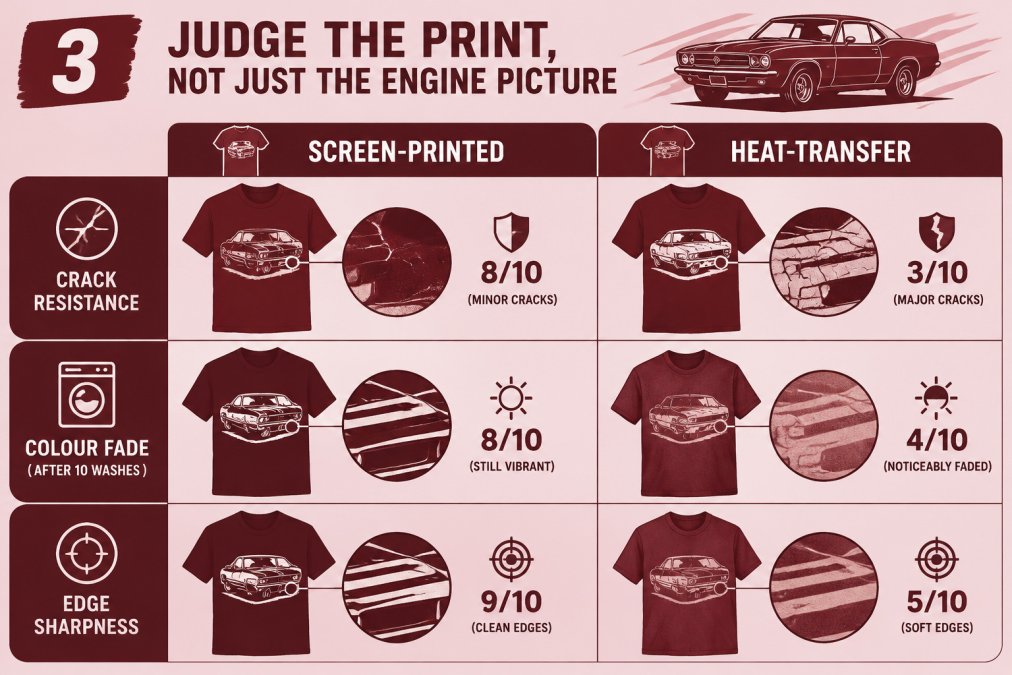
Here's the short version of the three methods you'll actually run into:
- Screen printing lays down thick ink through a mesh stencil. It flexes with the fabric, holds color well, and is the standard for serious graphic tees. The trade-off is that big, multi-color designs cost more to produce, so budget shirts often skimp on ink coverage.
- Direct-to-garment (DTG) printing sprays ink directly onto the shirt like a fancy office printer. It handles detailed, photo-like artwork beautifully, but the ink sits closer to the surface and can fade faster on dark fabrics unless the shirt was pre-treated properly.
- Heat transfer and vinyl press a printed film onto the fabric. It's cheap and fast, and it's also the method most likely to crack at folds, feel stiff, and peel at the edges after a few hot washes. If a listing won't tell you the method, assume it's this one.
So how do you judge a print you can't touch? Fuzzy edges, a glossy plastic sheen, or a design that looks like it was photographed off a screen are warning signs. Read the reviews and search them for the words 'cracked,' 'peeled,' and 'faded', reviewers are brutally honest about print failure in a way they rarely are about anything else.
| Print Type | Crack Resistance | Color After 10 Washes | Edge Sharpness |
|---|---|---|---|
| Screen-printed | Good, flexes with the fabric | Holds close to original | Crisp lines |
| Direct-to-garment | Moderate, depends on pre-treatment | Fades gradually on dark shirts | Detailed but softer |
| Cheap heat-transfer | Often cracks at folds | Visible fading | Soft or peeling edges |
Watch out: A seller who hides the printing method is usually hiding it for a reason, assume the worst and let the reviews confirm it before you buy.
Step 4: Choose Short-Sleeve or Long-Sleeve Classic Muscle Car T-Shirts for Men
Short sleeves are the default for summer shed sessions and weekend cruises. They breathe, they show off a bold front design, and they're easy to throw on with jeans or cargo shorts.
Long sleeves earn their keep the other 300 days a year. A long-sleeve tee protects your forearms from exhaust heat and the odd sharp panel edge, and it works under a hoodie when the garage is freezing. If you want one shirt that does everything, a long-sleeve classic car graphic is the more versatile pick.
Our tip: own one of each. Short sleeves for the heat, long sleeves for the grind.
Step 5: Find Funny Classic Muscle Car T-Shirts for Men Without Cheesing Out
There's a fine line between a clever gag and a shirt that makes everyone wince. Good humour in car apparel usually comes from the shared pain of the hobby: the parts run that went sideways, the "quick job" that took the whole weekend, the partner who asks why the car is still in the driveway.
Keep the joke short and the graphic clean. A witty line under a classic V8 reads like a mate taking the mickey out of you, which is exactly the point. A shirt that tries to be a stand-up routine across the chest just looks desperate.
For a shed-themed laugh with some personality, have a look at Sassy Shed Queen Front Design Only. It's a good example of a design that gets a grin without shouting.

Step 6: Wear It and Care for It So the Print Survives the Shed
Even a well-made shirt dies young if you treat it badly. Turn it inside out before washing, use cold water, and skip the dryer where you can. Heat is the enemy of printed graphics, and tumble drying cooks the ink. Hang it up and it'll outlast three lazy-dried shirts.
Pre-treat grease stains as soon as you can with a dab of dish soap, then wash as normal. Letting oil sit overnight is how a rag becomes a permanent feature.
Your Next Move: Book Your Size Check and Pick a Design
You now know what separates a tee that survives the shed from one that gives up by Christmas: the era you love, a fit that works for real work, a print that flexes, and a sensible care routine. Oily Rag Apparel builds its shirts for people who actually get their hands dirty. Browse our Mens Long Sleeve Tees and find the one that will still look good after the next blown gasket.
Frequently Asked Questions
Where can I find classic car T-shirts?
Start with dedicated automotive apparel retailers, including Oily Rag Apparel, which stocks graphic tees built around classic and muscle car designs. Pricing and current stock vary, so check the brand's website directly for the latest options and sizing charts before you order.
How do I style a muscle car T-shirt?
Keep the shirt as the loud part of the outfit. A black classic muscle car tee works under an unbuttoned flannel for a garage-to-pub look, or with dark jeans and boots for a casual weekend. For something more dressed up, layer a fitted long-sleeve version under a denim jacket. Avoid pairing a heavy graphic with other busy prints, because the car should be the only thing shouting.
Are short-sleeve or long-sleeve muscle car shirts better for everyday wear?
Short-sleeve tees are the default for warm weather and for anyone who spends most of the day moving around the shed or the street. Long-sleeve versions suit cooler months, add some protection from sun and minor splashes of grease, and give the print more real estate. Choose based on your climate and how much time you spend under the bonnet rather than on looks alone.
What should I look for in a vintage-inspired car T-shirt?
Look at the fabric weight first, since a heavier cotton holds its shape and print better than a thin, see-through blank.


