


Cart
0

Last Updated: November 2, 2026
Quick Summary
Heavy duty workwear costs more because heavier fabric, denser weaves, reinforced construction and durable finishes all add manufacturing expense. Looked at as cost per wear rather than sticker price, the cheap option often ends up costing more over time because it has to be replaced again and again.
- Check fabric weight in oz/yd², but also look at weave type and published abrasion or tear data.
- Double-needle seams and bar-tacks at belt loops and pocket corners signal real construction investment.
- Turn garments inside out and check for finished, non-fraying edges before buying.
- Divide the price by how many times you'll actually wear the garment to get the true cost.
- Wash oily work clothes separately, pre-treat grease, and skip fabric softener to extend their life.
Table of Contents
- Why Your Cheap Garage Gear Keeps Dying on You
- Fabric and Raw Materials: Where the Money Goes First
- Workwear Fabric Durability: What the Numbers Actually Mean
- Construction, Stitching and Why Reinforced Work Pants Cost Extra
- Workwear Cost Per Wear: The Math That Changes Your Mind
- Keeping Oily Gear Alive: How to Wash Oily Mechanic Clothes Without Ruining Them
- Booking Your Next Gear Upgrade Without Regret
- Frequently Asked Questions
Why Your Cheap Garage Gear Keeps Dying on You
Let's be honest: you've bought the cheap hoodie from the big-box store, worn it twice in the shed, and watched it pill, fade and split at the elbows before the month was out. We've been there. Heavy duty workwear costs more for reasons, and once you see them, the price tag stops looking like a rip-off and starts looking like a strategy.
Cheap garage gear isn't broken. It's doing exactly what it was designed to do: look fine on a hanger and survive a trip through the store. The shed is a different test entirely. Engine oil, brake dust, sharp edges and a dozen trips through the washing machine will find every shortcut the manufacturer made.
Fabric and Raw Materials: Where the Money Goes First
Here's where the money goes first, and it's not glamorous. Fabric is the foundation of everything. Heavier, tighter-woven cloth uses more raw fiber, more energy to process and more finishing steps, and every one of those costs gets baked into the price. A lightweight blend is cheaper to source, cheaper to dye and cheaper to ship, which is exactly why it dominates the budget end of the rack.
If you want a deeper look at why heavier construction holds up better over time, our guide on why heavy duty hoodies last longer than lightweight ones walks through the differences.
Workwear Fabric Durability: What the Numbers Actually Mean
Fabric weight is the number most people ignore and the one that matters most. Garment weights are usually listed in ounces per square yard (oz/yd²), and a heavier fabric generally means more material between you and the next scrape. But weight alone is a lazy shorthand. Two fabrics at the same weight can behave very differently depending on fiber, weave, and finish. Here's what the spec sheet is actually telling you, and what it's quietly leaving out.
Fabric weight (oz/yd²). This is the starting point. Lightweight shirting often lands around 4-5 oz/yd², midweight workwear around 7-9 oz/yd², and heavy-duty canvas or denim can run 12 oz/yd² and up. Heavier fabric costs more because it uses more raw fiber, more energy to weave and finish, and more shipping weight. That's a real cost driver, not marketing fluff. But a 12 oz/yd² fabric with a loose weave can abrade faster than a 9 oz/yd² fabric with a tight weave, so weight is a floor, not a ceiling.
Abrasion resistance. This is the spec that actually predicts how a garment dies in a garage. Labs measure it with a machine that rubs fabric against an abrasive surface and counts cycles until a hole appears (you'll see this reported as Martindale or Taber cycles depending on the test method). Higher cycle counts mean the fabric resists surface wear longer. Most budget workwear doesn't publish this number because the number isn't flattering.
Tear strength and tensile strength. Abrasion is surface wear; tear strength is what happens when fabric catches on a sharp edge and rips. Measured in pounds or newtons, tear strength tells you how much force it takes to propagate a tear once it starts. Reinforcement at high-stress points (pockets, belt loops, knees) matters here, but the base fabric sets the ceiling. A fabric with low tear strength will fail at the seam even if the seam itself is bulletproof.
Weave and finish. Tight, dense weaves resist abrasion and snagging better than loose, open weaves. Twill and canvas are workwear staples for a reason: the diagonal weave packs more yarn into the same area and sheds debris. Finishes matter too. Some fabrics get a durable water repellent (DWR) finish to shed oil and water; others get a mechanical finish to soften hand feel. Every finish is a cost step, and every finish can wear off over time. A DWR that quits after ten washes is not the same value as one that survives fifty.
What 'heavy duty' legally means (spoiler: not much). In the U.S., 'heavy duty' is not a regulated term for general workwear. It's marketing. The exceptions are garments sold as personal protective equipment (PPE), which may need to meet standards like ANSI/ISEA 107 for high-visibility apparel or NFPA 2112 for flame-resistant clothing. If your job requires PPE, the standard number on the label is the spec that matters, and the price reflects the testing and certification behind it. If your job is garage work and you just want gear that survives, you're shopping on abrasion, tear strength, and construction, not a government stamp.
The practical takeaway. Look for published weight, weave type, and abrasion or tear data. If a brand won't share any of it, assume the numbers are average at best. Our advice on choosing fabrics for garage workwear covers which materials suit which jobs, and our guide on why heavy duty hoodies last longer than lightweight ones digs into the hoodie-specific version of this argument.
Construction, Stitching and Why Reinforced Work Pants Cost Extra
Fabric gets you partway there. Construction is what keeps seams from letting go at the worst possible moment, and it's where the price gap between budget and heavy-duty gear gets widest. A single-needle seam run at high speed on a production line is cheap. A double-needle felled seam, a bar-tack at every stress point, and a crotch gusset are not. Each one adds machine time, skilled labor, and quality checks, and those costs land on the tag.
Stitch type and density. Single-needle stitching is one row of thread. Double-needle stitching is two parallel rows, which distributes stress across more thread and fabric and dramatically reduces seam failure. Stitch density (stitches per inch, or SPI) matters too. Too few and the seam is weak; too many and the fabric perforates and tears along the stitch line.
Bar-tacks at stress points. A bar-tack is a short, dense zigzag stitch used to reinforce spots that take repeated pull: belt loops, pocket corners, fly openings, and the tops of side seams. Every bar-tack is an extra operation on a sewing machine.
Knee panels and gussets.
Seam finishing and edge treatment. Raw, serged, or taped seams each cost different amounts. Taped or bound seams resist fraying and abrasion at the edges, which is where cheap garments fail first. Look at the inside of a hem or the edge of a pocket bag. If it's a single raw edge with a loose overlock, expect it to fray. If it's folded, bound, or taped, someone spent time on it.
Hardware and trims. Zippers, snaps, and buttons are small line items with big failure consequences. A cheap zipper that fails at month three turns a $60 jacket into a $60 rag.
The inspection checklist. Before you buy, turn the garment inside out and check four things: (1) double-needle or felled seams at high-stress areas, (2) bar-tacks at belt loops and pocket corners, (3) reinforced knee or elbow panels if the garment claims them, and (4) finished, non-fraying edges. If a garment passes all four, the construction premium is probably real. If it fails two or more, you're paying heavy-duty prices for budget construction.
Why this matters for cost per wear. A seam that fails at month four doesn't just cost you a repair; it costs you downtime, a replacement, and the hassle of shopping again. The construction premium is really an insurance policy against the most common failure mode in workwear: seams and stress points giving out before the fabric does. That's the math behind the next section.
Workwear Cost Per Wear: The Math That Changes Your Mind
Here's the part that changes most people's minds. Sticker price is the wrong number. The useful number is cost per wear: what you pay divided by how many times the garment actually earns its keep before it's retired.
The chart below shows how three tiers of garment compare over a 24-month period, with purchase price and replacement frequency both factored in:
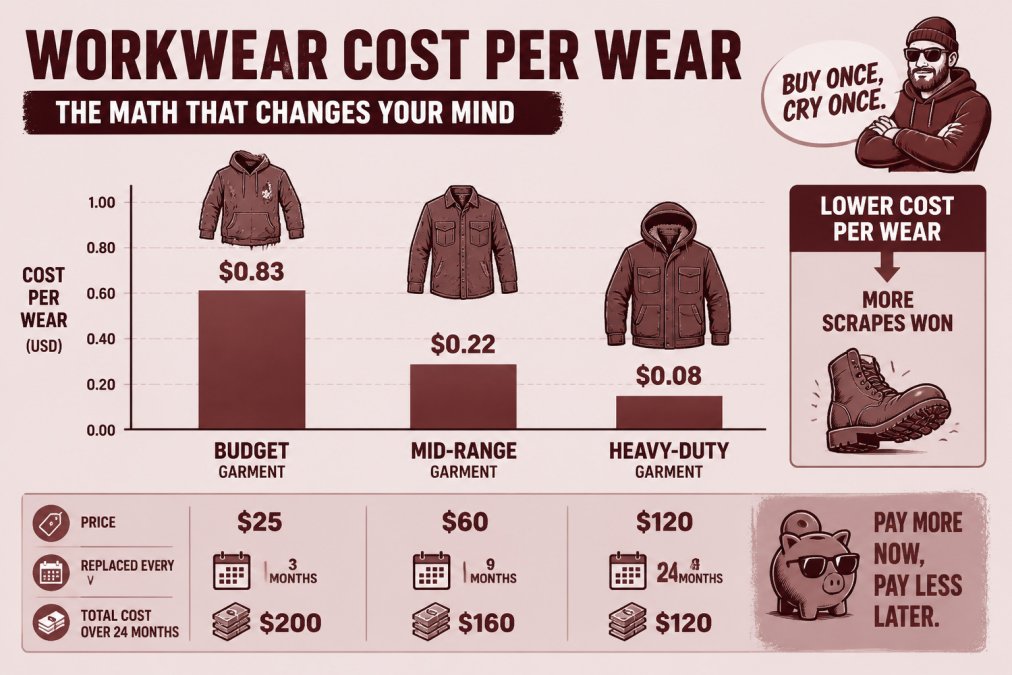
A budget piece that lasts three months and gets replaced eight times over two years can cost more in total than one heavy-duty piece that outlasts the whole stretch. Run the numbers on your own wardrobe and the cheap option often loses. Dollar figures here are illustrative, so plug in the prices you actually see.
The chart below shows how three tiers of garment compare over a 24-month period, with purchase price and replacement frequency both factored in:
| Garment tier | Typical lifespan | Replacement pattern |
|---|---|---|
| Budget piece | About three months | Replaced eight times over two years |
| Heavy-duty piece | Outlasts the 24-month window | Likely replaced at most once or not at all |
Keeping Oily Gear Alive: How to Wash Oily Mechanic Clothes Without Ruining Them
Even the best gear dies young if you wash it wrong. Pre-treat grease spots with a degreasing dish soap before they set, wash darks separately in cold or warm water, and skip fabric softener, which coats fibers and reduces abrasion performance over time. Air-dry when you can, because high dryer heat weakens fibers and can set oil stains permanently.
Watch out: throwing oily rags and work clothes into the same hot load is how a good hoodie picks up a permanent stain. Wash greasy items separately and give them a pre-soak first. For a complete walkthrough, see our guide on how to wash oily mechanic clothes and our tips for cleaning grease from mechanic shirts.
Booking Your Next Gear Upgrade Without Regret
So why does heavy duty workwear cost more than you think? Because you're paying for fiber, density, construction, finishing and a garment that lasts through the work instead of falling apart halfway through it.
If you're ready to stop replacing gear every season, shop the best mechanic hoodies for men and see the difference for yourself. Pricing depends on the piece and size, so check the current listing for exact figures.
Frequently Asked Questions
Why does heavy-duty workwear cost more than regular clothing?
Heavy-duty workwear is generally built from denser, tougher fabrics and sturdier construction. Those materials and extra production steps cost more to source and assemble. Pricing also depends on the brand, sizing range and where the garment is made, so compare specifications rather than sticker prices alone. Check any brand's current prices directly on its website.
Is heavy-duty workwear worth the extra cost?
It is worth it when you wear the gear hard and often. If a cheap pair of work pants tears or fades within a few months, you may spend more replacing them than you would on a tougher pair that lasts a year or more. Divide the purchase price by the number of wears you expect to get, then compare that cost per wear across options. Gear you only wear occasionally rarely justifies a premium.
Does expensive workwear last longer?
Usually, but not automatically. Higher-spec garments tend to use heavier fabric, stronger seams and better finishing, which extends their working life. Care matters just as much: washing oil-stained gear in hot water with harsh detergents can break down fibers and coatings faster. A well-made garment that is laundered properly will outlast a cheap one that is abused and neglected.
How should you care for oily mechanic clothes to make them last?
Pre-treat grease spots with a degreasing dish soap or a dedicated stain remover, then wash the garment separately from everyday clothes in cold or warm water. Avoid overloading the machine, which limits rinsing. Skip fabric softener, which can coat work fabrics and reduce their ability to shed oil. Air-dry where possible, since high heat can weaken fibers and set stains.


